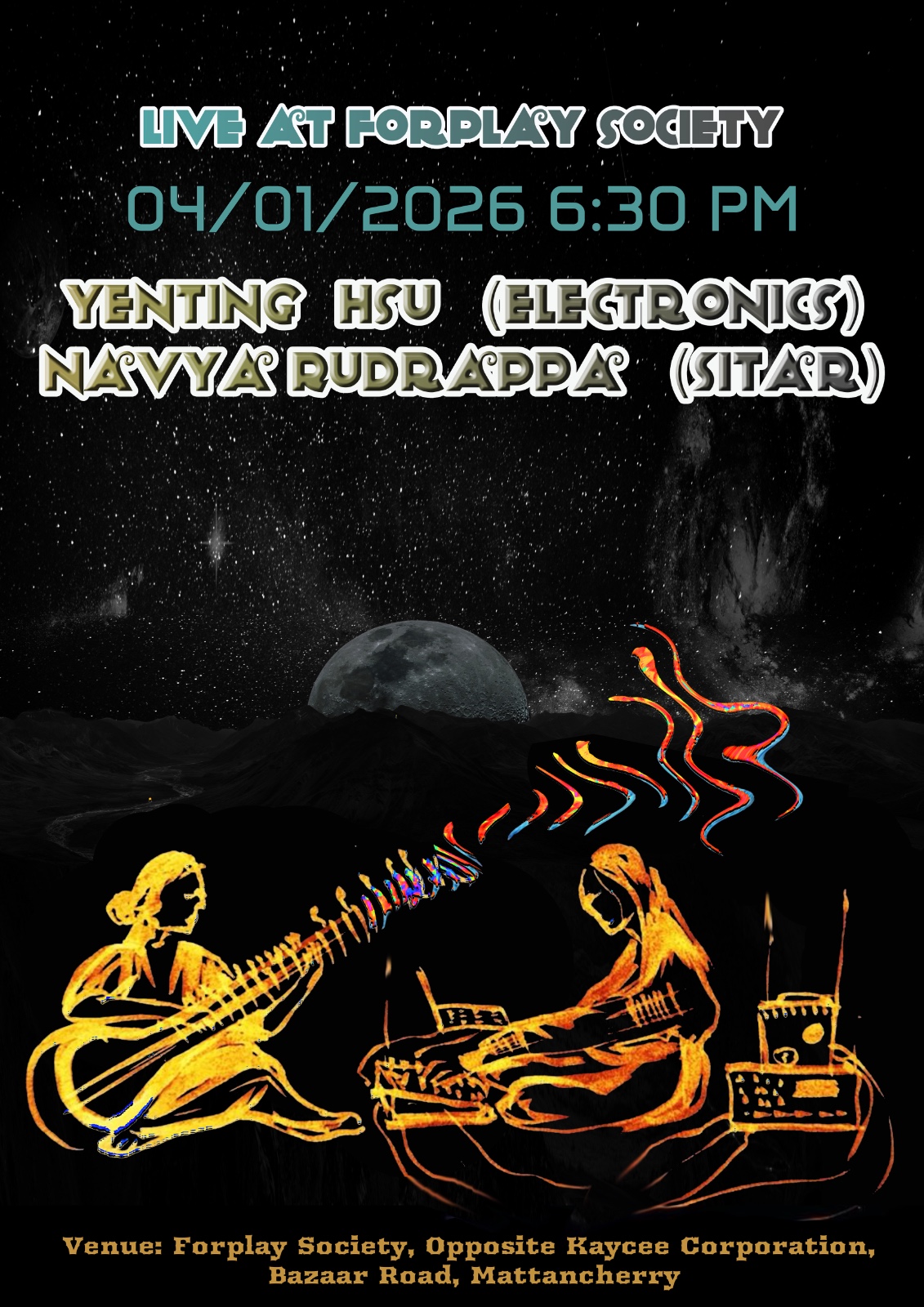
Yenting Hsu is a taiwanese electronics based composer and sound artist and will collaborate with Navya Rudrappa (Sitar) for this exceptional evening at Forplay Society. In 2025 Yenting Hsu was invited by C.Rockefeller Center and Netzwerk Medien Kunst to be part of the residence exchange program between Treasure Hill artist Village Taipeh and C.Rockefeller Center in Dresden and presented together with Seljuk Rustum an concert for the underwater soundsystem at Toskana Therme Bad Schandau, Germany.
Using the medium of experimental sound collage, Yenting Hsu explores the cultural context and structure of sounds. Her works often reflect the relationship between sounds, environment, individual and/or collective memories and emotions. Hsu weaves field recordings with electronic sounds and objects, exploring and experimenting with documentary and fictional/narrative and imaginary elements of the recorded sounds. In combination with other artistic media and disciplines, Hsu creates installations, performances, audio documentaries, electroacoustic music, and much more. She also works as a sound designer/composer with dance theaters and film studios.
Her work has been shown at the Taipei Artist Village, the Taipei Fine Arts Museum, the Taitung Art Museum, the Digital Art Centre – Taipei, the ChengLong Wetlands International Environmental Art Project (Taiwan), the Taipei International Documentary Festival, the Asian Meeting Festival (Japan), the Festival Film Dokumenter (Indonesia), the Toyama Glass Art Museum (Japan), Perth Institute of Contemporary Art (Australia), Fremantle Arts Centre (Australia), the Lacking Sound Festival Taipei, and many more.
Navya Rudrappa is an Indian sitar musician whose practice is rooted in the Hindustani classical tradition while remaining open to contemporary and cross-cultural contexts. Based in Bangalore, she has spent more than a decade immersed in the rigorous study of raga and tala, developing a performance language that emphasizes both structural clarity and expressive depth.
Her musical training has been shaped by long-term mentorship under established teachers of Hindustani classical music, with a strong focus on the gayaki ang (vocal-inspired phrasing) approach to the sitar. This grounding in tradition forms the basis of her solo performances, which foreground attentive listening, gradual temporal unfolding, and the subtle articulation of tonal nuance.
Alongside classical recitals, Navya Rudrappa engages in collaborative projects that situate the sitar within broader cultural and social frameworks. Her work often explores dialogue between musical lineages, instruments, and performance contexts, reflecting an interest in how classical forms can resonate within contemporary artistic discourse. With a background that also includes work in architecture and education, her artistic perspective is informed by an interdisciplinary sensitivity to space, structure, and process.
Navya Rudrappa’s practice navigates continuity and change, honoring the depth of the classical tradition while opening it toward new encounters and meanings within today’s cultural landscape.