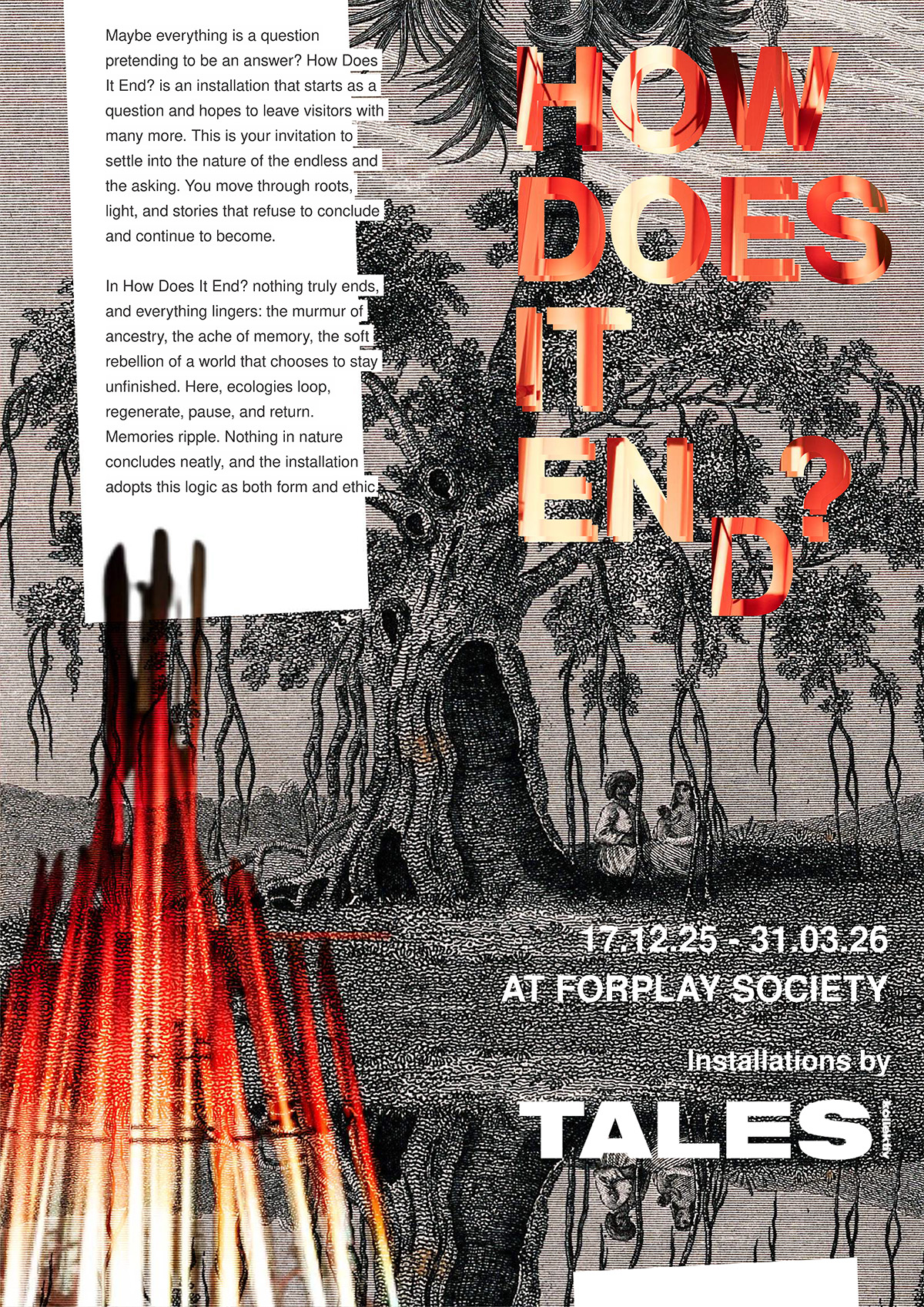
What do roots know that branches forget?
How Does it End? is a story terrain that invites you into the changing rhythms of places, time, allusions, senses, songs and stories. Moving through roots, luminance and memory,itwishes to take a visitor into the folds of uncertainty and the never-ending nature of stories that we inhabit, inherit and invent.
Spatially, the exhibit is an interplay of materials – appropriated perennial shrub Aripoo (Lantana Camara), programmed LED strips, and repurposed shipping ropes, creating an intimate space for our collective voices to be held and be heard. The exhibit invites one to sit and slowly sip the allure of what we have always shared in the warmth and safety of trees and fires – the memories that root us, the hopes that move us and the spaces that linger in their meeting.
Questioning futures of our pasts, and accepting that nothing in nature concludes neatly, How Does it End? makes space for ecologies that loop, regenerate, pause and return.
Foregrounding the politics of the locality, the work extends to a public program that listens to and partakes in stories told by Kerala-based storytellers – from puppetmakers and indigenous musical archivists to shadow puppeteers, food artists, filmmakers, and more.
–
01: Aripoo / Indigenous Creativity
Lantana Camara, or Aripoo as it’s colloquially called in Kerala, is a perennial shrub native to the tropics of South America. It was first introduced in South Asia by the British Colonial administration as an ornamental plant. In a little over 200 years, it has disrupted native ecosystems, reduced biodiversity, and is now considered a critical agricultural and ecological challenge across the region.
And yet, this colonially invasive species, when encountered with indigenous knowledges and crafts, turns a curse into a blessing. Lantana Crafts is an organisation that works with indigenous communities in the forests of western ghats of Karnataka and Tamil Nadu.
For this exhibit, crafters of the Soliga community transformed this invasive plant spatially to celebrate indigenous aesthetics and art making. Lantana Camara swivels through How Does It End? questioning and regurgitating the complexities of belonging, migration, borrowed identities and the shifting realities that shape us.
02: Thee / Convivial Technology
The warmth and instinct of gathering, imagining and meaning-making have travelled with us through millennia. In stories, songs, dance and mixing of voices, we have found communities, continuity, safety and each other. Huddling around a fire has been one of the most ancient instruments of bringing us together. We affirm this primordial practice and extend it as a literal site of coming together. The fireside incorporates 4200 LEDs upon 60 odd towers creating an audiovisual illusion of a digital campfire. The LEDs are programmed to respond to movements, sound and your presence. ‘Motherflame’ is an invitation to dreamwalk between technology, nature and art.
03 : Kadha / Telling Tales
Contrasted with Aripoo (Lantana Camara) an invasive plant, Aal Maram/ Banyan trees (Ficus Benghalensis) is a native perennial to South Asia, their deep integration into the regions’ ecology, culture and mythology has venerated them to the status of ‘wisdom tree’ and in many cases a village gathering space. In How Does It End? you sit below this iconic tree, recreated with repurposed fishing/shipping ropes. A place to pause and re-emerge, the tree lends its shadow for you to ask questions that have simmered under your skin, or walked with you for days short and long. Here, read what others have returned to in their quiet hours, listen to the faint murmurs that have kept some awake through the nights, toy and turn over the curiosities many amongst us wonder about, and when you find the moment, pick a pen and add one of yours.
ABOUT
TALES Kollektiv is a Berlin-based, international non-profit multimedia initiative creating globally exhibited, award-recognised work that connects cultures, deepens ecological awareness, and celebrates our shared humanity. With over a decade of experience, TALES’ portfolio spans films, books, exhibitions, games, workshops, and publications, including immersive installations, curated dialogues, and multiplayer experiences, brought to life through co-creation and community-driven, interdisciplinary methodologies.
During the pandemic, they began developing World of Us, a multiplayer children’s game co-created with Indigenous communities in India, Brazil, Congo, and Romania. Their process embraces non-linearity and continual reimagining. TALES Kollektiv is interested in breathing life into stories that grow rather than conclude.
Articultural Society is a co-operative society for artists and cultural workers from Kerala and beyond. It aims to organise artists and cultural workers into a decentralised, democratic, and interdependent network based on co-operative principles and community economics.
The logo of Articultural Society is inspired by Shaheed Bhagat Singh’s broad vision of revolution, symbolised aptly by ‘Gehun aur Gulab’ (Wheat and Rose). This egalitarian version of revolution does not just fill bellies (wheat) but also proposes conditions to love, make art, and express oneself and our collective selves culturally. This vision of the revolution calls for not just full bellies but a full ‘cultural awakening’.
Articultural Society is a humble step in that direction. It emerges from many conversations, solidarities, and urgencies. It is an attempt to imagine a shared cultural ground shaped by cooperation rather than competition, by community rather than isolation.
Articultural Society is a South Asian affiliate of SAVVY Contemporary, Berlin.
We open this space as an invitation to think together, to co-create, to gather, to share and to imagine otherwise.
Forplay Society is a non-profit independent artist-run performance space, residency and artist- community driven experiment founded by Seljuk Rustum, that has existed since 2016 in Ernakulam, Kochi. It has since then gone through various iterations and most recently took the form of a society in 2022 to create a spontaneous action-based union facilitated by artists and curators.
Since its inception, Forplay has self-funded, produced, and curated a broad spectrum of contemporary artistic practices, including performance art, free improvisation, media art, and experimental music. It has served as a hub for artistic networking, hosting local and international artists from the USA, Japan, Spain, Bulgaria, Germany, Sweden, Austria, and Finland. Forplay Society has also introduced workshops and performances covering theatre, dance, puppetry, soldering, welding, printmaking, experimental sound design, improvisation, and writing.
SAVVY Contemporary | The laboratory of form-ideas is an artistic organisation, discursive platform, place for good talks, foods and drinks – a space for conviviality and cultural plurilog. As a public and independent organism in perpetual becoming, it is animated by around 25 members and a network of collaborators, co-creating community and communities it breathes with. SAVVY Contemporary situates itself at the threshold of the West and the non-West to understand their conceptualisations, ethical systems, achievements, and ruins. It develops tools, proposes perspectives and nourishes practices towards imagining a world inhabited together.
The space was founded in 2009 in Berlin-Neukölln by Bonaventure Soh Bejeng Ndikung, SAVVY’s artistic director until 2022. From 2023 to 2025, the space – located in Berlin-Wedding since 2016 – was under artistic direction by Renan Laru-an. Currently, SAVVY is under executive direction by Lema Sikod and Lynhan Balatbat-Helbock.